
How to open a mini-bakery from scratch?
Owning your own mini-bakery- is not only about the aroma of freshly baked bread, but also one of the most viable formats in the HoReCa industry. Whether you are planning a small kiosk near the subway or a cozy bakery in a residential area, the demand for high-quality and fresh bread, croissants, puffs, and buns is growing every day. But how do you turn this idea into a profitable mini bakery business without making mistakes at the start, where to start, and what do you need to open a mini bakery?
This article is a step-by-step guide that will help you understand all the details of opening a restaurant. We will also tell you how to organize a mini bakery, what documents to draw up, where to look for premises, which formats work best in your city, how to choose equipment for a mini bakery, and what to consider to move from idea to launch.
Business registration
Any business should start with its legalization, and opening a mini bakery is no exception. After all, legalization is the foundation on which the entire structure of your business will rest. If you do not pay due attention to this at the start, you will have to spend time and money correcting mistakes in the future.
So, how to open a mini bakery from scratch officially? The first step is to register a sole proprietorship or LLC. The format is chosen depending on the scale. For a small bakery with one point of sale, a sole proprietorship of the 2nd group is sufficient. If you plan to open several outlets or work with large volumes, it is better to register an LLC right away. The next step is to determine the KVEDs. You can choose two main ones: 56.10 “Activities of restaurants, provision of mobile catering services” and 10.71 “Production of bread and fresh pastries”. This will allow you not only to sell baked goods but also to make them yourself. You also need to prepare the following documents:
- a permit from the State Emergency Service;
- certificates of conformity for products;
- Sanitary and epidemiological conclusion for production;
- medical books for employees.
Searching for premises and choosing a location
After registering your business, you can safely begin the process of finding premises and choosing a location for your mini bakery. Up to 70% of your success depends on the location, so choose a place not only based on the rental rate, but also on traffic potential, target audience, and logistics convenience. The best locations are:
- residential areas with dense development;
- locations near cafes, shops, pharmacies;
- premises near the metro, offices or educational institutions.
Requirements for the premises
Choosing a premise is not just about a good location. There are clear requirements for the premises of a mini-bakery in Ukraine, which are determined by the State Service of Ukraine for Food Safety and Consumer Protection, the State Emergency Service and local authorities, and which your establishment must meet. The main requirements include:
- the area of the premises is from 20 to 50 m², depending on the format (production only or with sales);
- ventilation, water supply, electricity (10-15 kW minimum);
- area for washing, cold storage, production, and sale of baked goods;
- unobstructed access to bathrooms and the staff area.
Therefore, in the business plan for a mini bakery, you should definitely take into account the cost of repairs in accordance with these requirements.
Equipment
The most expensive part of starting a mini bakery is the equipment. However, it determines how well and consistently you will be able to bake, serve customers, and scale in the future. The list of basic equipment for a bakery includes:
- a deck, rotary, convection, electric or gas oven;
- flour sifter;
- dough mixer
- Dough tumbler;
- a table for processing the dough;
- a proofing cabinet in which the dough is proved;
- baking trays for baking;
- racks for finished products and goods;
- refrigerators for dough and raw materials;
- equipment for washing.
In addition, the business plan for opening a mini bakery should include not only the purchase of equipment, but also service, spare parts, and logistics.
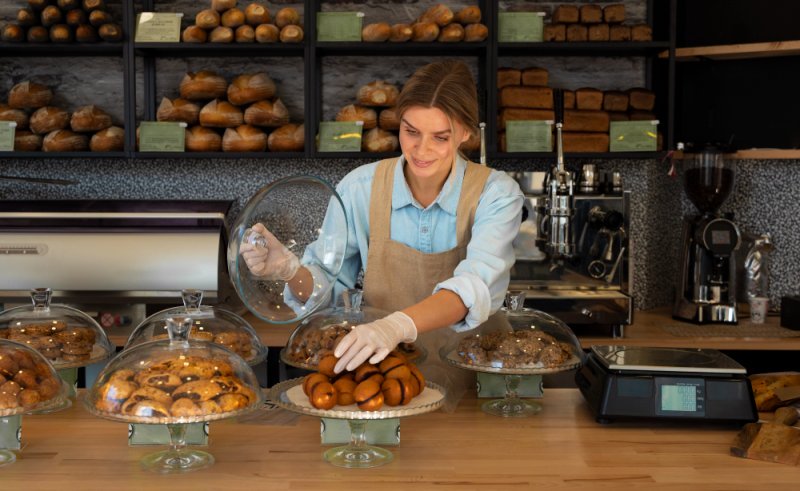
Assortment of the bakery and pricing policy
Many newcomers to the restaurant business take the issue of the assortment of a mini bakery lightly, but it is often the one that determines the success of the business. It is necessary to think over the assortment even before you form a business plan. Therefore, before developing a menu assortment, it is important to
- clearly define the target audience: morning customers, young people, office workers, mothers with children;
- take into account the location: near coffee shops, add sweet pastries to the menu, and for a bakery located near a bus stop, office, or educational institution, add hearty pastries with meat or vegetable fillings;
- determine the price segment: economy, medium, premium;
- consider trends: gluten-free and whole wheat flour, original recipes, French pastries.
For example, the basic assortment for launching is:
- Batons and baguettes;
- Rolls with sweet filling;
- Puffs with apple, mushrooms, ham;
- Sweet and savory croissants;
- Seasonal items – hala, stolen, Easter cakes
In order for everything to work like clockwork, it is important to calculate the Mini Bakery business plan, taking into account the cost of each item, margin, and production volume. This will help to avoid losses and a constant negative balance.
Automation of the bakery
Automation is one of the key factors that will help your mini bakery not only survive, but also grow. Imagine the situation: a lot of customers, a large flow of orders, several suppliers, and several employees who have to interact in a coordinated manner. If you don’t implement a control and analytics system from the very first day, you’re in for a mess.
To avoid this, start by implementing basic automation. The most effective tools are:
- POS system with sales accounting – allows you to see the real picture of sales for each item;
- CRM system – if you plan to make deliveries and accept pre-orders.
- Automatic orders to suppliers – save you hours of routine work.
Marketing and promotion
You can have the best bread in town, but if no one knows about it, you’ll be left with full shelves. That’s why advertising and marketing are critical elements on the way to opening a mini bakery. Here are the basic tools to help you promote your mini bakery:
- SMM promotion – Instagram and TikTok with behind-the-scenes videos, customer reviews, and launches of new items.
- Geotargeting – advertising to a local audience on social media, Google Maps, and YouTube.
- Offline promotion – tastings, opening day promotions, merchandise (bags, T-shirts), advertising on billboards in the neighborhood.
- Integration with cafes and coffee shops – partnerships when your baked goods are taken by other establishments.
Content marketing – creating a blog, participating in local media, launching campaigns.
And most importantly, marketing should not be a “residual” part of the budget. It needs to be integrated into the business plan, because it will bring your first guests to you, create hype, and ensure repeat sales.
If you are ready for this challenge, but don’t want to spend years making mistakes and trying blindly, you should bring in experience. The Modern Chef team will help you at every stage: from choosing a location and preparing documents to developing a menu, finding suppliers, and launching a turnkey mini-bake business. You will only have to choose what to bake – a crispy baguette or airy croissants.
Discuss project
How it works
1
You leave a request on the site or call us by phone +38 097 020 11 02
2
We contact you and arrange a meeting.
3
We listen carefully to the essence of your task.
4
Based on what we heard, we will offer you several options for solving your problem.